
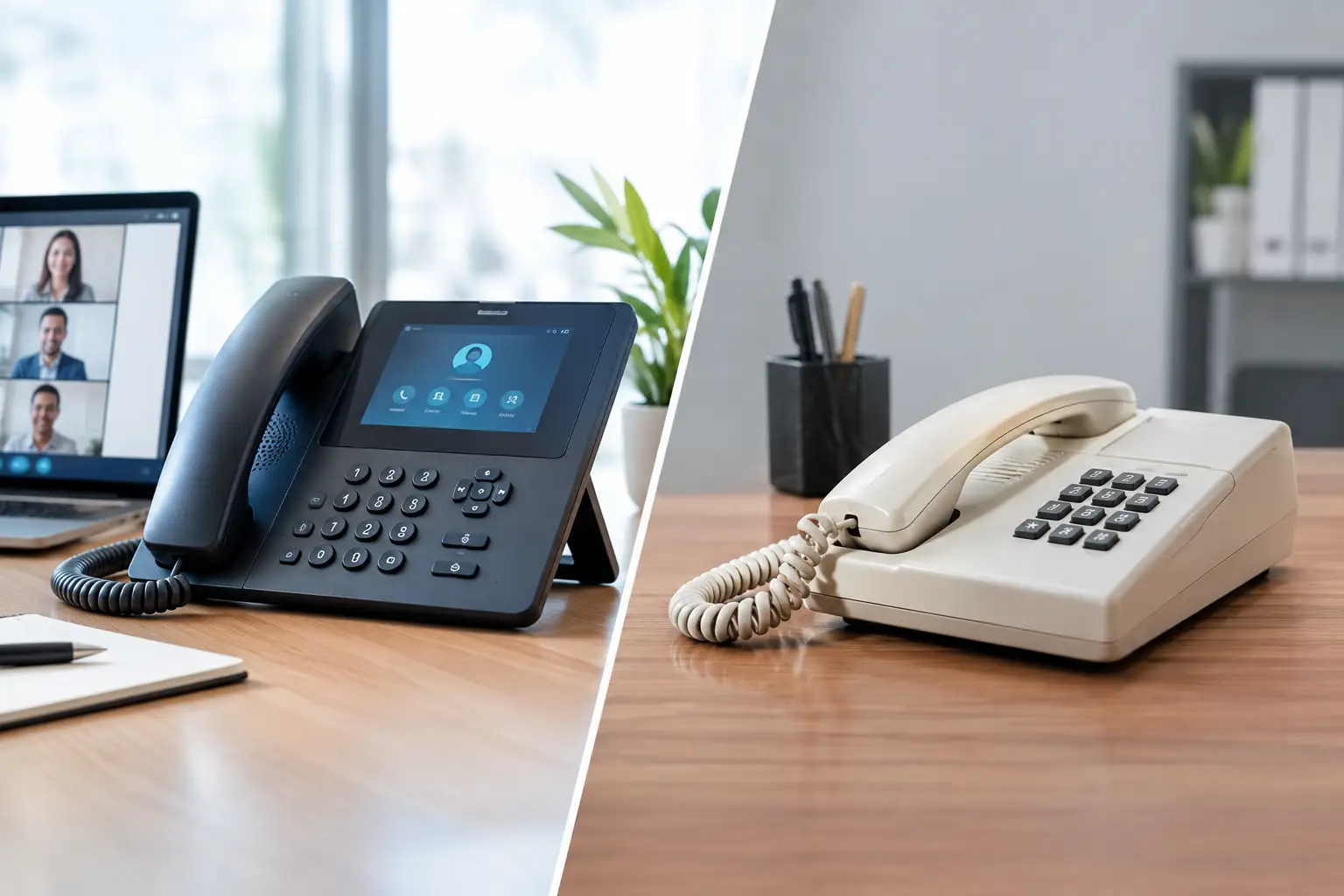
VoIP Versus Analog Lines: Which Fits Your Office?

Updated: Nov 16
A phone system decision usually becomes urgent when something changes: a carrier raises a bill, an old PBX fails, employees need to answer calls from home, or a new office opens. The question of VoIP versus analog lines is not just about old technology versus new technology. It is about choosing a service that matches how your staff works, what your building can support, and how much complexity your business actually needs.
For many small businesses, VoIP is the practical choice because it adds flexibility and can reduce recurring costs. Analog lines still have a place, especially for certain safety, fax, alarm, and low-use applications. The right answer depends on the job each line needs to do.
What is the difference between VoIP and analog lines?
Analog phone service is the traditional phone line most people recognize. A physical copper line carries voice signals from your office to the telephone network. Older desk phones, fax machines, elevator phones, alarm panels, and some specialty equipment were designed around this type of connection.
VoIP stands for Voice over Internet Protocol. Rather than traveling over a dedicated copper phone circuit, calls travel over an internet connection. A VoIP service can work with desk phones, a computer application, or a mobile app. It can also provide familiar business-phone features such as extensions, call transfers, voicemail, auto-attendants, call groups, and after-hours routing.
The comparison can be misleading if it is treated as a simple choice between physical wires and internet calls. Many providers are retiring traditional copper infrastructure. A service labeled as an "analog" line may be delivered through a digital adapter rather than a true copper circuit. That distinction matters when you have equipment that requires a specific type of line or dependable power behavior during an outage.
VoIP versus analog lines: the practical differences
The most useful way to compare these options is to look at reliability, flexibility, cost, and the equipment you need to support.
Reliability depends on the full setup
Traditional analog lines have long been valued because a true copper line can continue operating when commercial power is out. A basic corded phone may still work even if the office loses electricity. That is a real advantage for locations where outages are common or where a phone must remain available during an emergency.
VoIP relies on your internet connection, network equipment, and electrical power. If the internet, router, switch, or phone system loses power, calls may be affected. That does not make VoIP unreliable. It means the system should be designed thoughtfully. A quality internet connection, properly configured network, battery backup for essential equipment, and call forwarding to mobile phones can provide a dependable business calling setup.
If uninterrupted service is critical, ask specific questions. Does the provider offer automatic failover? Can incoming calls route to cell phones when the office is down? Is your modem or router on backup power? Clear answers are more valuable than broad promises about reliability.
VoIP offers more ways to work
An analog line is straightforward: it rings at a connected phone or device. That simplicity is useful for a single lobby phone, a fax machine that must remain in place, or a rarely used emergency line.
VoIP is built for a business where calls need to move. An employee can answer an office number at a desk, from a laptop, or through a mobile app. Calls can ring multiple people, go to a department queue, follow a schedule, or route to an answering service. A caller can hear a professional menu without the business needing a large, complicated phone system.
For a small office, that can replace workarounds such as giving out personal cell numbers or manually forwarding a main number every evening. The feature value is not about having every option available. It is about making sure customers reach the right person without placing more work on the staff.
Monthly cost is only part of the picture
VoIP is often less expensive per user or line than traditional analog service, particularly when a business needs several extensions or calling features. It may also reduce the need for separate services if one platform handles calling, messaging, meetings, and mobile access.
But low advertised pricing is not the same as a low total cost. Ask whether taxes, regulatory fees, equipment rental, installation, user licenses, support, number porting, and early termination charges are included. A plan that looks inexpensive can become hard to compare once those items appear on a bill.
Analog service may cost more per line, and rates can rise as legacy networks are maintained or phased out. Still, paying for one analog-type line can be sensible if it protects a vital device or avoids an expensive equipment replacement. The goal is not to eliminate every analog connection. It is to avoid paying for analog lines that no longer serve a clear purpose.
Equipment compatibility deserves attention
Most modern business desk phones work well with VoIP, and many existing phone numbers can be moved to a new service. However, not every device behaves the same way on VoIP. Older fax machines, alarm communicators, credit card terminals, elevator emergency phones, gate systems, and medical or security equipment may have special requirements.
Do not assume that an adapter will solve every issue. Before changing service, make an inventory of every device connected to a phone line and confirm how each one communicates. For life-safety or regulated equipment, the manufacturer, monitoring company, or local authority may have requirements that go beyond basic dial tone.
This is one area where a hybrid setup can make sense. Your main office phones may move to VoIP, while one specialty line remains in place or is replaced with a purpose-built cellular or compliant alternative.
When VoIP is usually the better fit
VoIP is generally a strong fit for a business that wants extension dialing, a main number that can ring employees wherever they are, or better control over incoming calls. It is especially useful for offices with hybrid staff, multiple locations, seasonal call volume, or a need to add and remove users without rewiring the building.
It also makes sense when an old PBX is reaching the end of its life. A modern hosted phone system can retain the functions employees expect - transfers, hold, paging, voicemail, and department extensions - without requiring a large on-site phone cabinet.
The key requirement is a stable internet connection and a provider willing to explain the service plainly. You should know what is included, what hardware is needed, and who will help if calls are not working as expected.
When analog or analog-style service still makes sense
Keeping an analog line can be reasonable when the line serves a narrow, essential job. A basic emergency phone, legacy alarm panel, or device that cannot be economically upgraded may justify a dedicated connection. A true copper line may also be preferable at a site with frequent, prolonged power outages and no practical backup plan.
That said, businesses should verify what they are buying. The term "analog" is often used loosely. If your equipment depends on traditional line power, pulse dialing, fax reliability, or a specific emergency-calling arrangement, request the technical details in writing before making a change.
A simple way to make the decision
Start with your call flow, not a product name. Consider where calls should ring, whether staff work away from the office, how many extensions you need, and which devices must stay connected. Then look at your internet reliability and power backup options.
Next, separate your everyday business communications from specialty devices. Your front desk, sales team, and office staff may benefit from VoIP features, while an alarm panel or elevator phone needs its own solution. Treating every line the same is how businesses either overbuy a complicated system or keep paying for outdated service.
Finally, compare proposals based on the complete monthly cost and the support behind it. A clear proposal should identify service, equipment, installation, taxes and fees, contract terms, and any one-time charges. If the pricing or terminology is difficult to understand before you buy, it will not become clearer after the first bill arrives.
A good phone system should make it easier for customers to reach you and easier for your team to respond. Choose the option that supports that daily work with the fewest compromises, then build in the backup plan your business can depend on.


Comments